Sunday, 22 February 2015


Call For Papers – GLR (2015) 24(3)

Griffith Law Review
A Review Dedicated to the
Socio-Legal, Inter-disciplinary, Critical and Theoretical Study of Law

Editor-in-Chief – Professor William MacNeil
Managing Editors – Dr Edward Mussawir & Dr Timothy Peters

The Griffith Law Review: Law Theory Society has a proud history of publishing innovative and engaging socio-legal, inter-disciplinary and critical legal research. Our focus is international and we engage with worldwide issues and agendas. In recognition of the Review’s standing as a leading journal, it was ranked A* by the Australian Research Council for the 2010 Excellence in Research for Australia Initiative.
The Review is pleased to announce the following publishing opportunity for 2015.
 (2015) 24(3) Symposium
Through the Looking Glass: the Framing of Law and Justice through Popular Imagination
Symposium Editor: Cassandra Sharp
Deadline for manuscripts: 30 March 2015
This special edition is designed to explore the connected themes of legal storytelling and the visual image of law and justice in popular culture.  Following Alice, who contemplates, and then explores, the world on the other side of the looking glass, this special edition calls upon scholars to reflect on and encounter the concepts of law and justice as broadly framed within popular imagination via the portal of popular cultural texts. Alice goes through the looking glass to find a world both clear and recognizable yet inverted, or refracted, and so too, this symposium sought to explore stories and images of law in popular culture that are familiar, yet at the same time often turned strange.

Within this theme, scholars can investigate and revisit issues that map the contemporary discipline of law and pop culture – with its different dimensions and relations to legal knowledge, law practice and jurisprudence. The special edition seeks to allow for broad coverage under topics such as:

·       The role of legal storytelling in transforming, mirroring, creating, and sustaining legal consciousness.
·       The framing and/or distortion of law within popular images and narratives.
·    The transformation and circulation of meaning in relation to perceptions of justice, and/or how justice (dis)connects with law.
·       The (de)mystification of law through popular stories.

Submissions are invited for this Symposium Edition, which can be between 8,000 and 10,000 words in length, addressing any issue broadly conceived within this theme.

Dr Cassandra Sharp (Symposium Editor)

Submissions to the journal can be made at the following web address:

For more information concerning the GLR contact:
Dr Ed Mussawir & Dr Tim Peters
Managing Editors
Griffith Law Review
Email:
glr@griffith.edu.au
Website:
www.griffith.edu.au/criminology-law/griffith-law-review


Wednesday, 19 November 2014

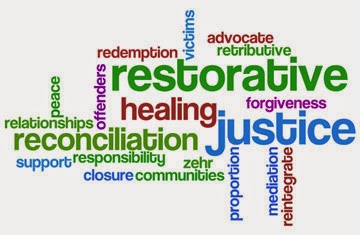
A burglar meets his victim? How would you respond to this story?


In this extremely visual age, I had the recent opportunity to simply listen to a story of justice through the medium of radio documentary. I had the privilege of reviewing for UOW's RadioDoc Review, a documentary produced by BBC Radio 4 in the UK, and I was amazed at my own response to not only the transformative effect of a burglar meeting his victim, but also to the way the radio medium so piqued my attention and provoked emotion. Reproduced below is a small extract from my review...


Stories of justice as presented in media reports play an important role in provoking responses to issues such as ethics, crime, punishment and social responsibility. With the punishment of criminal activity frequently attracting public attention and media reporting on sentencing contributing to an increasingly punitive public (Gelb 2008), it is rare to be invited to think differently about how ‘justice’ might be achieved (whether for the victim or the offender). And yet, this is exactly what A Different Kind of Justice does. To listen to this documentary produced by Russell Finch for BBC Radio 4, is to take part in a review of one’s own perspective on what should be the purpose of ‘justice’. It is a challenge to extend what might ordinarily be our primary natural desire for offenders to be punished, into a connected desire for the restoration of relationships and healed lives.  

A Different Kind of Justice, narrated by dialogue expert Karl James, explores the impact of a restorative justice program from a deeply empirical perspective. In interviewing, and then facilitating discussion between a burglar and his victim, James provides an exquisitely emotional look into the cathartic and potentially transformative impact of one particular restorative justice encounter in Blackburn, UK. A Different Kind of Justice, uses three distinct movements to re-tell a crime story by weaving together victim and offender perspectives, and in the process reveals not only the profound transformative effects of restorative justice on those participants, but also the impact it can have on the listener.

With recent studies suggesting that meetings between victims of crime and their perpetrators can both reduce reoffending rates and provide pyschological healing for victims (Bolitho et al, 2012), there has been a significant increase of these ‘restorative justice’ meetings in the UK. In this program, the story is narratively crafted using the interweaving of articulated memories – both Margaret (the victim) and Ian (the offender) describe their memories of the crime and their subsequent ‘restorative interaction’. It is in hearing these descriptions of juxtaposed and personalized memories that the listener is keenly aware of the raw emotion constituting this crime narrative. But, what is the particular story that has seemingly entwined their lives? As described in the Somethin’ Else Program Information, the essence of their story is this:

In November 2008, Margaret interrupted a burglary in her own home. As she came through the backdoor, the burglar left through the front. He had taken a laptop full of photos commemorating her daughter Jessica's 18th birthday. Eight months later her daughter was killed in a tragic car accident. The theft of the laptop meant her parents were deprived of any recent family photos of their daughter. …. inspired by the memory of her daughter, Margaret agreed to meet the offender in a restorative justice conference in Preston Prison. Ian was that burglar.

However, this is more than just a narrative of burglar meets victim. It becomes a gripping, metaphorical looking glass through which we can explore the practical realities of restorative justice, and the listener quickly realizes that this is a story of restoration, forgiveness, guilt, and burden. It is indeed a story of a different kind of justice.

To read my full review at RadioDoc Review click here. 


I encourage you to listen to the documentary for yourself - which you can do by clicking here and scrolling to the very end (after all the comments) to listen via soundcloud.

Wednesday, 11 June 2014

Check out my upcoming symposium....


The Legal Intersections Research Centre (LIRC) invites you to a Symposium
Through the Looking Glass: the Framing of Law & Justice through Popular Imagination

Date:            Friday 4 July 2014
Time:           9am – 5pm
Location:   67.202 – Moot Court
Register:   Online by 27 June
Registration is free. Places are limited


Following Alice, who contemplates, and then explores, the world on the other side of the looking glass, this symposium calls upon participants to reflect on and encounter the concepts of law and justice as broadly framed within popular imagination via the portal of popular cultural texts. Under this banner, presenters will investigate and revisit issues that map the different dimensions of a cultural legal studies approach to popular culture and its relationship with legal knowledge, law practice and jurisprudence covering issues such as:


·       The role of legal storytelling in transforming, mirroring, creating, and sustaining legal consciousness.
·       The framing and/or distortion of law within popular images and narratives.
·       The transformation of meaning in relation to justice, and/or how justice (dis)connects with law.
·       The (de)mystification of law through popular stories.

Keynote Speaker: JESSICA SILBEY
Biography: Jessica Silbey is a law professor at Suffolk University Law School in Boston, Massachusetts, USA. Professor Silbey’s scholarly interests and expertise is in the cultural analysis of law, exploring the law beyond its doctrine to the contexts and processes in which legal relations develop and become significant for everyday actors.  Professor Silbey has published widely in the field of law and film, exploring how film is used as a legal tool and how it becomes an object of legal analysis in light of its history as a cultural object and art form. She recently co-edited a book about law and television entitled Law and Justice on the Small Screen (2012).

Other presenters: Jason Bainbridge, Penny Crofts, David Papke, William MacNeil,   Cassandra Sharp, Kieran Tranter 

Convener: Dr Cassandra Sharp, Senior Lecturer, School of Law

Faculty of Law, Humanities and the Arts, UOW e: csharp@uow.edu.au